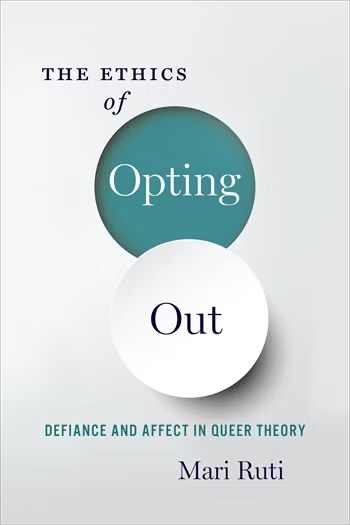
The Ethics of Opting Out – Mari Ruti
I’m late on things again, getting behind on all the chores and work and my commitment to post to this blog. This lateness is partly because my cat has been peeing outside of the litterbox every day for three weeks now and I spend half my time mopping it up. He’s suddenly decided to opt out of the system we’ve created for him, expressing his displeasure at the recent appearance of a new cat that showed up one night on our roof patio (and briefly perched on our bed, after it clawed its way through a hole in our window screen).
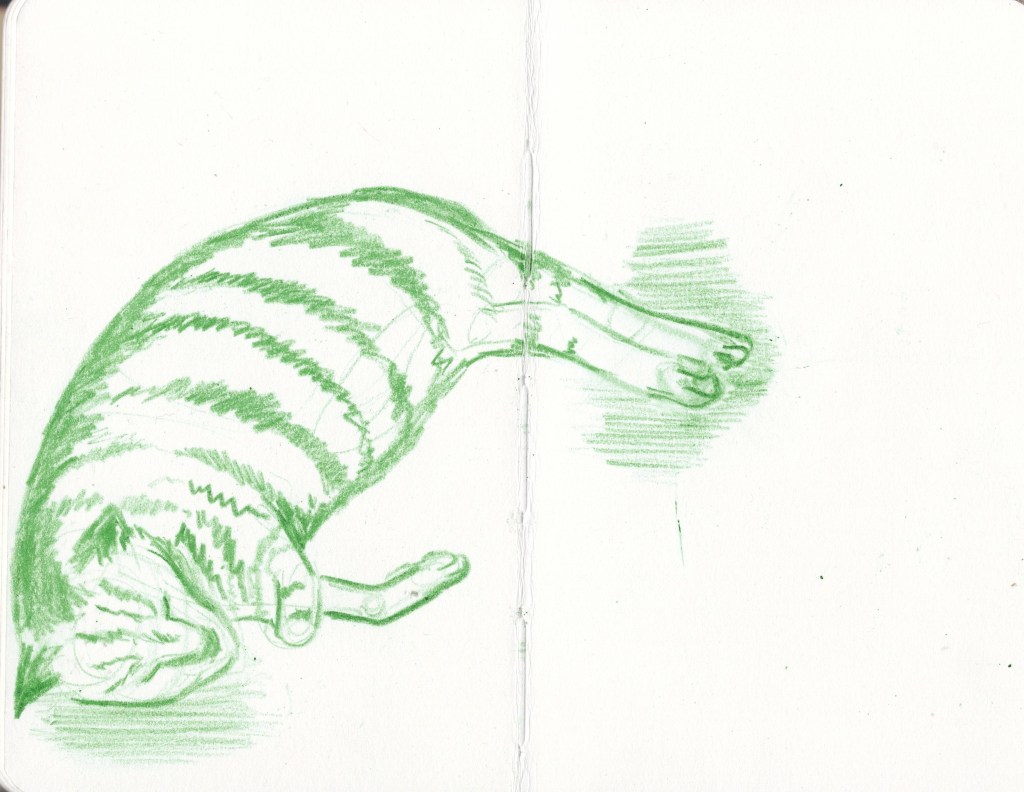
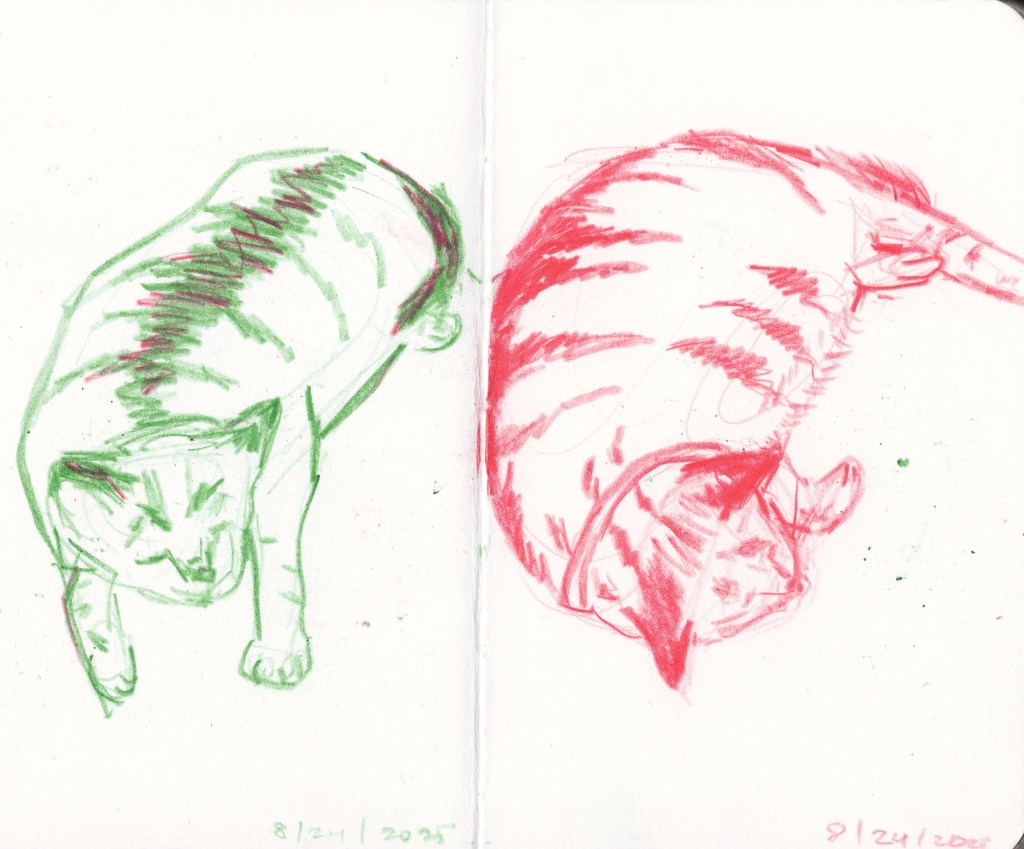
Ok, so maybe he’s not opting out of hegemonic power structures in quite the same way that I’ve been reading about recently. But these cats of ours always make me think about instinctive struggles for dominance and group dynamics and all of the ways we respond to those who try to control us.
I picked up The Ethics of Opting Out because I really wanted some more formal theoretical language for how a life can be lived under capitalism and a touchstone for modern ethics as a field. I also wanted to get in that state of mind where my thoughts feel more organized, like I can really think through ideas and not just skim above the surface of them. I’m often scatterbrained, and I love the way a good philosophy book can orchestrate my thoughts, for a time at least.
This book introduced me to both psychoanalytics and modern queer theory, some of which I’ll try to summarize quickly below, mostly just so I can continue remembering and absorbing what I read. I deeply enjoyed learning some basic psychoanalytic ideas and terms, even though my understanding remains very incomplete. Jouissance, the death drive, the analysand (what a great word!) – in each little word or phrase there can sometimes be many slippery concepts.
The big takeaway of Lacanian ethics according to Mari Ruti is a focus on “the subject’s relationship to itself”. There’s this concept that we are inextricably bound to a desire that formed before symbolism, before words, a desire unaffected by the Other (aka hegemony), a desire that makes us us, and that to be ethical is to be as true a servant of that foundational desire as we can be, to detach ourselves from all our false, learned-under-capitalism desires, and align our actions with that internal compass. It’s an attractive way to think about ethics, at least for me.
There’s lots and lots for me to chew on and agree with about the psychoanalytic view of neoliberal capitalism, too – all the ways that sanctioned rebelliousness allows us to remain productive, the twisted version of cruel optimism that keeps us going and going and going until we drop. Even our sanctioned version of rebelliousness gets more sanctioned and less rebellious every second; punk band t-shirts being sold at Target, ect. It’s bleak, but it’s always good to remind ourselves that the illusion of rebellion saps momentum from actual revolutionary practices.
A question posed in many ways by Ruti; how can one imagine a true alternative to humanist ethics (that dualistic, Disneyified battle between good and evil) without accidentally creating the mirror image of it? Can we really get over concepts of good and bad without recreating that same structure in reverse (humanist ethics bad, everything else good)? I agree with Mari Ruti in that I think probably, yes, we can, but we have to be precise and we have to allow in some ethical concepts without trying to destroy them entirely and replace them with (take your psychoanalytic pick here) jouissance, suicidality, the destruction of the self, ect. All “bad” feelings (deemed bad by hegemonic power, that is) are not ethically good, even though Ruti manages to cite many other authors who are ultimately trying to make it seem that way. But sometimes “bad” feelings can be singularly helpful in our struggle against capitalism’s tidal pull.
Ruti spends some time on Eve Sedwick’s paranoid hermeneutics of suspicion, which I found to be both a valid reading of current theoretical tendencies and also maybe just a good description of the way me and a lot of my friends think right now. This feels like an age of paranoia that we’re living through, one where if you don’t believe in a conspiracy theory or two, you’re most likely wrong. Critical theory in such a time can seem almost misguided (and, let’s be real, it often is), but it can also serve as one of many ways to imagine other worlds, and to describe what we have in this world at a slant, so we can better see what’s happening to us. Seems a lot like poetry to me in some ways.
The concluding section was pretty lovely – a written dialogue between Ruti and her student about the role of silence, how it can be a form of power and resistance and opting out. It’s really one of the best ways I’ve seen an academic book conclude, and it allowed Ruti to once again summarize some main themes of the book while also handing the microphone to her student so they could teach us something new.


Say hi!